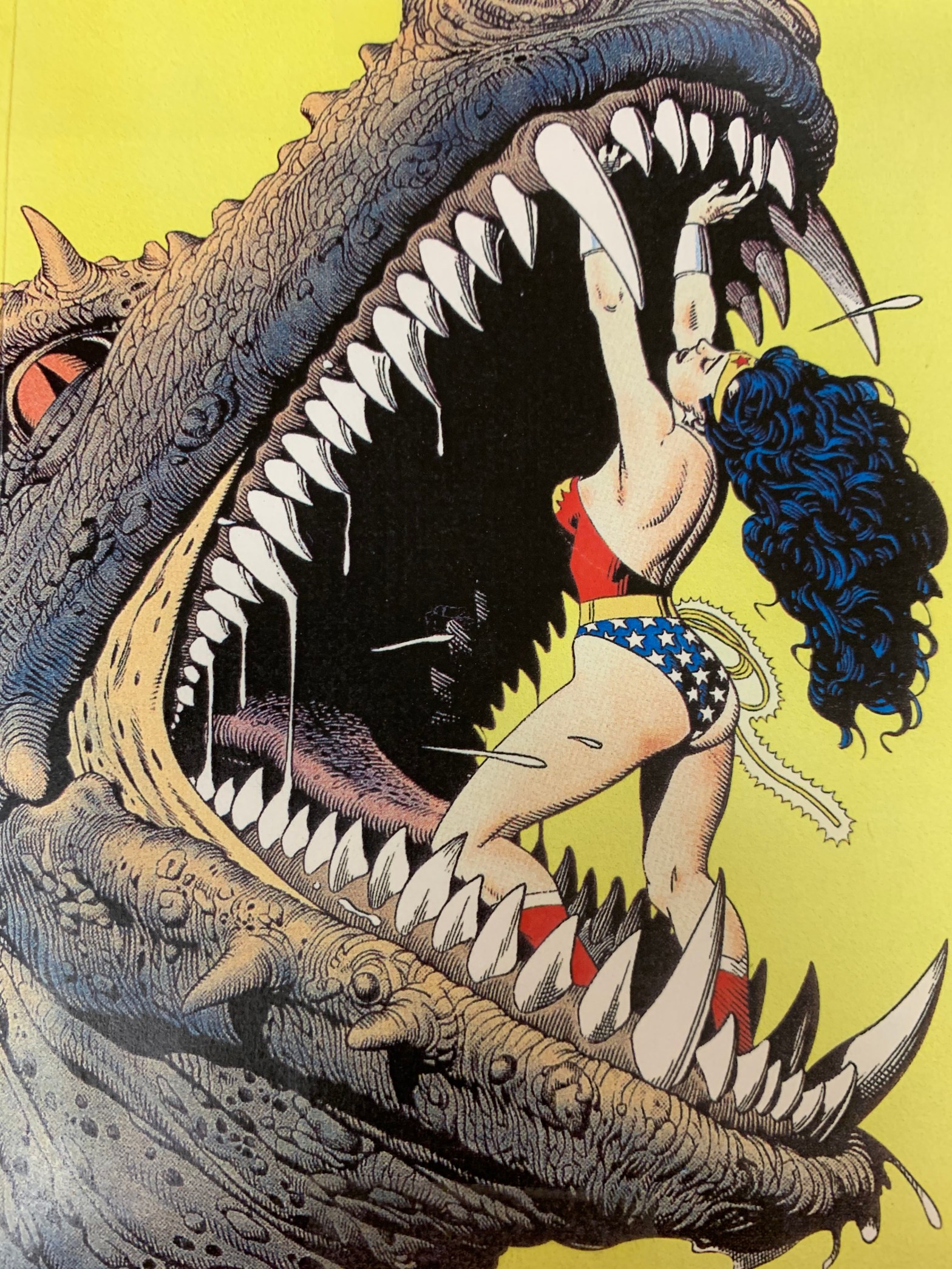
NB I’m positive there is a ton of fantastic radical feminist writing about Wonder Woman and feminist mythologies. I’m sure there is a lot I’m missing and much I’m getting wrong below. For now, this is a coherent, true-for-now narrative that captures my own experiences with childhood socialization toward the world of work.
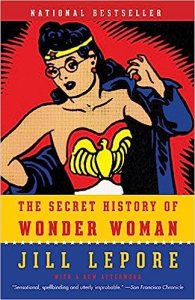
One of my best friends told me that after a major relationship breakup, he found it helpful to listen to music and watch shows he enjoyed before he had met that person. He deliberately reminded himself of who he used to be, and he mindfully reincorporated elements of that past self into his present self after that life transition. I’m reading Jill Lepore’s book, “The Secret Life of Wonder Woman” and planning to read the comics. And I’m watching the Wonder Woman tv show.
The Wonder Woman tv show is a three-season series that aired in the mid to late 1970s, starring Lynda Carter (Hi, Ms. Carter, if you’re reading this! OMG! [fans face with excitement]). The show aired during my adolescence and I remember watching the show, probably on syndication on a UHF channel. I’m only through the pilot episode so far, but to all the Bechdel fans out there, I perceive some troubling white feminism waters here. She’s gorgeous, she’s strong and capable, AND she rescues men from the foibles of their humanness. Once a man shows up, the conversations she has with women on Paradise Island are only about men. In the pilot episode, her own mother, Queen Hyppolyta, says, “I named this island “Paradise” for an excellent reason. There are no men on it. Thus, it is free of their wars, their greed, their hostility, their… barbaric… masculine… behavior.” [she bites her hand is the stage cue]. Wonder Woman saves Steve Trevor, such a good-hearted, loyal war hero who’s trying to save the world from the Nazis. She leaves Paradise and joins the world of men. She experiences a major life course discontinuity when she chooses to leave Paradise and her community. She engages in a lifestyle centered around being near Steve. The world of men and capitalism try to take advantage of her.
Wonder Woman theme song
(1975, by Norman Gimbel and Charles Fox)
Wonder Woman!
Wonder Woman!
All the world is waiting for you,
And the powers you possess,
In your satin tights,
Fighting for your rights,
And the old red, white and blue!
Wonder Woman!
Wonder Woman!
Now the world is ready for you,
And the wonders you can do.
Make a hawk a dove,
Stop a war with love,
Make a liar tell the truth!
Wonder Woman!
Get us out from under.
Wonder Woman!
All our hopes are pinned upon you,
And the magic that you do.
Stop a bullet cold,
Make the Axis fold,
Change their minds,
And change the world!
Wonder Woman!
Wonder Woman!
You’re a wonder!
Wonder Woman!
Glass ceiling, glass cliff
There was a recent conversation in higher ed journals about the fact that six of eight Ivy League presidents were soon to be women. And the hand wringing begins about what it means. First, I long for the day when gender and racial equality milestones in the workplace can be placed squarely in the past. Second, I sincerely hope that these presidents choose liberation as their leadership style and don’t act as foot soldiers of patriarchy, capitalism, and identity-based oppression. Third, I hope they aren’t part of a set-up to fail.
The glass ceiling was coined in 1978 by Marilyn Loden to represent invisible barriers to advancement for people of a marginalized demographic. In 2005, the term glass cliff was coined in 2005 by Michelle Ryan and Alexander Haslam to reflect an employment phenomenon where women and racial minorities are more likely to advance into leadership during times of crisis when the risks of failure are greatest. Strong women. Charismatic, compassionate women. Smart, capable, wise women. They are set up to rescue and renew systems but are also set up to fail. Place these Wonder Women in situations where our workplace purpose is to nurture, comfort, restore the community to sanity. We see her as our mother. But we place too many burdens, expectations, responsibilities, and emotional labor on her while giving her insufficient resources of time, staff, and balance. With the glass cliff, we create a situation where she has to choose between herself and work and a strong man replaces her to do the paternalistic job of taking care of everything. It’s a cultural behavior pattern I think we are stuck in.
I am that woman. I believe I’m one of those Wonder Women. I experienced first the glass ceiling then the glass cliff. This post is really about how a Greek mythology became a modern mythology became a lesson story became a parable became a cautionary tale became became a cultural narrative many of us perpetuate, re-enact, and live by.
My childhood origins in Wonder Woman
My Wonder Woman really got activated right around the 2016 election. Tchotchkes everywhere. Saving people, rescuing bad situations, showing up anytime. I’m a moth to a flame about these situations; it’s a learned subconscious behavior, when I see a situation calling for Wonder Woman, there I am. Many women are socialized into this call-response behavior pattern. My grandmother was a young adult in the 1940s (hello, WWI, Great Depression, and WWII) when Wonder Woman in comic book form first appeared. My mother was a young adult in the 1970s (hello, Vietnam War and fuel crisis) when Wonder Woman in television form appeared. With all we’ve been through in the past 7 years, that Wonder Woman behavior of rescuing patriarchal systems from their own foibles has been very, very activated in me. But that learned approach isn’t working for me anymore. It has caused me too much harm, hurt, exhaustion, and troubling feelings. Much of that harm I’ve done to myself in continuing to rescue others and systems from drowning while I myself lack a life jacket for the situation. There’s a part of me that feels so much shame, humiliation, resentment, and sadness for falling into the trap of that system-response pattern so many times.
People say why don’t you just stop doing that? It’s important for me to say that this Wonder Woman behavior pattern is a traumatic response. I learned early that if I didn’t save the system and be the nurse to the wounded of the system, really bad things would happen (hello, complex ptsd and codependent behaviors of managing, mothering, and martyrdom). Even if that’s not true anymore. It’s very hard to turn off a survival strategy I have had since I was in preschool. Believe me, I know it’s killing me. If I knew how to just turn off the behavior so it would stop killing me, I would. I have wanted to reject that side of me. Cut it out and cut it off.
So many invisible Wonder Woman ways and enabling cultures and relationships form the scaffold of my life – what I know how to do, my certifications, the reputation that precedes me, my communities, my ability to be the strong woman people want at a time of crisis, upheaval, and transition. “I’ve been training for this my whole life.” I sometimes feel stuck in the wheel of fate, an unbreakable reactive, defensive cycle of insanity-making: the world of men move their chess piece like this, then I, Wonder Woman, must move my chess piece like that. They want the one who can steady the boat and nourish the passengers until we are actually rescued (by…yeah…probably a strong man. The Great Being protect them if it’s a strong woman or man of color after the strong white woman). I’m not resentful or angry about it, and I’m not a killjoy. I just feel ready to get off the carousel and to relinquish the parts I have played in perpetuating the cycles.
I’m watching Wonder Woman to reclaim who I was before I became a Wonder Woman myself in my early childhood, before I was socialized into being a white woman professional in the US. I’m just completing the pilot episode so I have a ways to go. But already I’m able to see a warm, concerned side of Wonder Woman and I feel drawn to the aspects of her authentic, pre-contact self. I know I am that version of Wonder Woman in many [admittedly transgressive] communities I helped to create.
Work is not your identity
I have a button from my former employer that says “#IUisHome.” It’s not though. It was a place I worked. I had many wonderful relationships through my employment there and many transcendent experiences in communities with grad students and colleagues. I am full of gratitude for what I have learned about what matters to me and how to put my strengths to right service in nurturing communities of care and concern. But my growth was stunted within that employment contract. Some recent book titles come to my mind: “Work Won’t Love You Back (Sarah Jaffe). “The Good Enough Job” (Simone Stolzoff). “The Problem with Work” (Kathy Weeks). I have things to do and ways to be at home with myself and others that couldn’t grow anymore by employment within that academic context. For now, I believe I learned what I needed to learn from within. In leaving monogamous academic institutional employment, I am giving others the opportunity to pursue their life’s curriculum, learn their own lessons, and be on their soul’s journey.
Wonder Women everywhere, I salute you. I’m putting down my shield and sword of warrior-level white woman saviorism, workism, and self-negation. I need to restore and bring back to balance some of my former Paradise Island self.
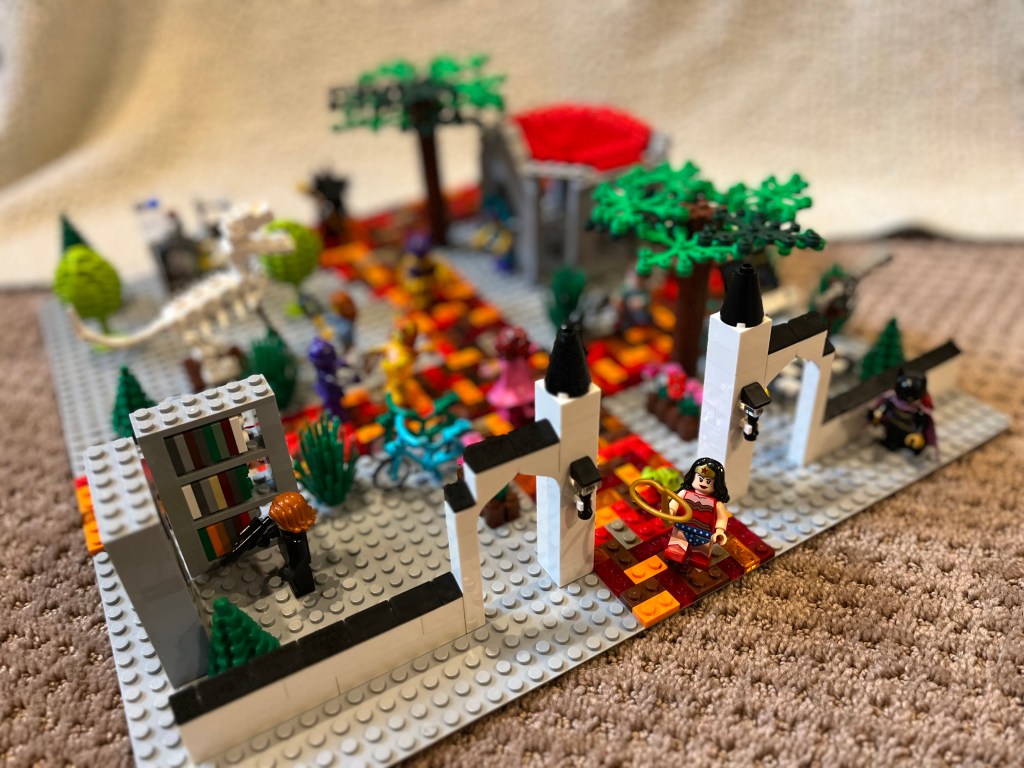
 Katie Kearns