
Last Friday, I taught for the first time in nearly 20 years. It was the first day of a semester-long course. The last time I taught a course, with a syllabus and 16 weeks of lectures and grades, was when I was a lecturer of undergraduate biology from 2001-2005. Since then, the teaching I’ve done has been in the context of pedagogical workshops I led, learning communities I facilitated, and graduate student instructors I coached one-on-one while employed in a university teaching center for almost 15 years between 2005 and 2019.
Hello, Self-Doubt #1 (Do I know enough about pedagogy to teach it?)
With about two weeks to prepare before the start of this fall semester, I said yes to this invitation to teach a graduate pedagogy course. I’ve never constructed my own “dream syllabus” on graduate pedagogy. This feels like an incongruent fact about me considering all my years of working in educational development; the faculty and graduate students I coached in their pedagogical practice; the communities I facilitated among pedagogy faculty; the pedagogy courses I visited, observed, and facilitated workshops in; and research I collaborated on about graduate-level pedagogy courses and course design institutes. In case you want to see some of those studies, here’s a courageous plug:
- The development and evaluation of a doctoral-level public health pedagogy course for graduate student instructors;
- Survey of Instructors of College Pedagogy in the United States and Canada;
- This multidisciplinary comparison of graduate-level pedagogy courses offered at a large midwestern university; and
- This multi-institutional, hybrid approach to teaching course design for graduate students and postdocs.
Despite coaching so many people through their own decision-making, I never stepped back and asked myself what I would do and why with a graduate pedagogy course. Somehow, I never, ever gave a thought to how I would want to teach my own graduate course in college pedagogy. I never invited myself to develop self-awareness and self-authority within that community of pedagogy faculty.
Hello, Self-Doubt #2 (Can I cultivate a good-enough, meaningful, reasonable, semester-long experience for graduate students about college pedagogy?)
Now that I have the opportunity, I think I have both decision-paralysis and self-doubt. I spent a lot of time in the last two weeks agonizing over the principles and approach of the course, what we would focus on, why those things, and how we would proceed. I’ve seen so many different ways people have approached the construction of their graduate courses in college pedagogy. I can list off examples of so many different syllabi, learning objectives, topics, readings, and assignments; my local university teaching center maintains a list of these pedagogy courses. I have an assemblage of college-level Preparing for College and University Teaching, the CIRTL Network learning outcomes, and the Community of Inquiry Model. And yet, I’m finding it hard to sift, winnow, and synthesize all of those resources and personal experiences into my take–my unique voice and contribution–on a semester-long exploration of essentials of college pedagogy for graduate students.
The semester- and year-long learning communities I facilitated, such as Intersections of Identity and Instruction and classroom inquiry (i.e., Scholarship of Teaching and Learning, Teaching-as-Research, and Discipline-Based Educational Research) were probably the closest to classroom-based teaching I’ve done recently. We had weekly readings, “assignments” for accountability, discussions, and final projects in weekly gatherings that occurred by facilitation, consensus, group conscience, and shared authority. However, these were co-curricular experiences for which graduate students did not earn academic credit. None of these communities had the legitimizing institutional indicators of a course listed with the registrar, that students enroll in and pay for, taught by a faculty member who had the program’s formal approval, for grades and academic credit on a transcript.
Hello, Self-Doubt #3 (Can I teach this class without it taking over my life and well-being?)
It felt extraordinarily right, self-evident even, to say yes without hesitation to the invitation to teach the class. I knew it was an experience I needed. I needed to build trust in myself and my ability to right-size my life. I needed to feel like I wasn’t drowning in problems I didn’t create, couldn’t control, and couldn’t cure. I needed to know to my core that I could put my strengths into service that mattered to me, that made an observable difference, and that I could reasonably manage. It was a way for me to synthesize and put a capstone on years of pedagogical work I had done at this institution. Teaching a graduate course in college pedagogy with a dozen enrolled graduate students seemed like a right-sized job at the right time in my life. Whatever self-doubts (“imposter fears”?) I held, teaching this class seemed like a therapeutic and manageably courageous way to show myself that I had the knowledge and expertise to make good-enough decisions about how the class would go. I put my trust into my community-building strengths as well as with the grace and compassionate honesty of the students to collectively maintain through group conscience the kind of community we wanted together. I also put trust in my community of friends and colleagues doing similar work to respond with resources and a listening ear when I ask for it.
A little bit about the course
I’m sharing the pedagogy course syllabus and highlighting a few key decisions. The syllabus and my thoughts here represent my thinking as it stands today, one week into the semester and after one class meeting. Much of it isn’t complete as of this writing. I know there are critiques to make, gaps to find, and flawed thinking. I’m sure we will have experiences and conversations that change my mind about decisions I’ve made so far in what we read, what we participate in, what we write about, and what we discuss. I’m hoping for a “falling forward” experiment as I learn together with my students in this iteration of a graduate course in college pedagogy.
Whose shoulders do I stand on?
This syllabus draws upon my research interests in the first-person value and meanings of belonging that graduate students, especially historically excluded grads, make of their experiences in institutional learning communities (especially teaching communities) outside their academic programs. I give gratitude to the hundreds of graduate students I have interacted with who have taught me about their experiences, dreams, and hurdles in becoming reflective teachers. I am also grateful to the colleagues and mentors who shared their pedagogical materials with me. Academic elders including bell hooks and Parker Palmer, who have been influential in my thinking about communities of teaching practice, were touchstones for this classroom space. Practices and approaches I tried to incorporate included:
- Microclimates & counter-spaces
- Counter-narratives & counter-storytelling
- Witnessing & testimonio
- Accompaniment & care
- Feminist praxis & resistance
My role as facilitator
I’m not interested in being the expert of the class with the definitive answers. Instead of “here’s what you need to learn,” it’s “how can I support your goals?” I want to be a facilitator (as in, smoothing some paths), coach, mentor, and guide for the pedagogical adventures my students are choosing. Yes, I am the instructor responsible for the assignment of grades on work typically submitted in pedagogy courses. I acknowledge the responsibility I have for students taking this class for their major, minor, or certificates. I’ve exerted authority by making some decisions about the readings; with How Learning Works as the central text, I also chose articles and book chapters I’ve used in other learning communities that graduate students often found productive in broadening and refining their thinking about pedagogy. Still, I see those reading choices as potentially productive places to start, and I sincerely hope students will share additional readings they discover during the semester. In that way, I hope to learn more about these same topics by being a member, participant, and co-learner in the class.
Class as community of teaching practice
In designing the class, I thought about what makes me and each student a unique asset to this pedagogy course. We are a phenomenon of a specific assortment of people with unique backgrounds, experiences, knowledge, and motivations agreeing to meet weekly for three hours. Our pedagogical knowledge and experiences go into the collective middle for each of us to draw on as needed. I want each of us in the class to trust each other with our teaching reflections, to be facilitators of each others’ learning, and to listen for the nuggets of shared wisdom. I want to encourage care for each other’s experience in our class, in their own classrooms, and beyond the construct of classrooms, to whatever extent they feel comfortable doing so. On the first day, we each shared an object that was meaningful to us, a chance to get to know about each other’s artistic and musical talents, Lego creations, pets and fauna, the way we adorn ourselves, our possessions, and our environment.
Self-discovery and self-awareness
Rather than tell them what good teaching is, I want them to explore their teacher integrity and identify pedagogical choices that suit them. I want my students to have experiences that help them clarify their values, preferences, principles, and approaches. Maybe this class isn’t so much a class about pedagogy, rather it’s a meta class about how to learn about pedagogy. Assignments aren’t about proving right answers from research articles to me and discussions aren’t “paper-bashing” sessions; both are opportunities to explore and reflect on how our readings, discussions, workshops, classroom observations land for them and why. Everything we do is a possibility for the graduate students to grow and clarify their teacherly identity, to make connections between theory and practice, abstract and concrete, aggregate and personal, seen and heard, read and embodied. They are also opportunities for me to hear asynchronously what each of them is wondering about, to shine back the glimmers I hear in their reflections, and to offer nudges in potentially productive directions.
Building networks
I want my students to build and curate a pedagogical resource network of people, communities, knowledge, and practices that support the kind of teacher they want to be in the classroom. Our readings come from a range of fields about college pedagogy, including sociology, learning sciences, educational psychology, scholarship of teaching and learning, and writing studies. They will observe classes in other disciplines and participate in campus pedagogy activities. They will get to meet and talk with people in my network of pedagogical practitioners who cross organizational and institutional boundaries.
Bonus content
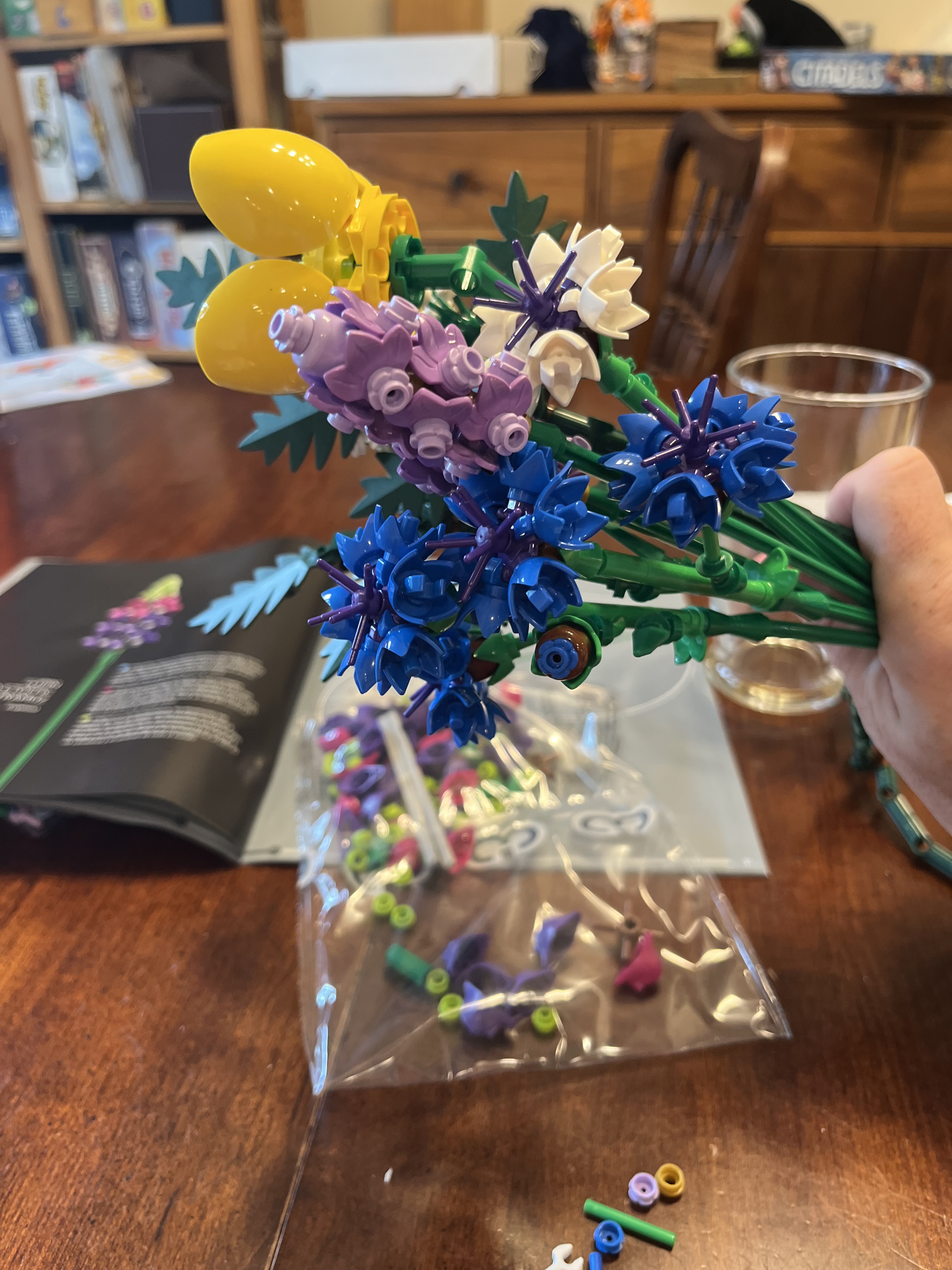
So how did the class go? I had a really good experience and I think the students did, too. And then building cooling system failed on the hottest, muggiest day of the year thanks to a heat dome climate event. We ended class early when the building manager sent us all home (honestly, I wish I had made the decision myself to end class about 30 minutes before that). My papers were moist, the air was stagnant, the floors were slick with condensation, and the halls and parking lot were ghost towns. It was definitely a memorable end my first day of teaching a graduate class. As a reward to myself, I went shopping at the mall with my son for a Lego. Voila, my Lego wildflowers!
 Katie Kearns
2 thoughts on “Facing self-doubt: Teaching a grad pedagogy course”