
*Special thanks to core members of the Sakae Sushi, CIRTL After Dark, and Zoombeer crews who are all major contributors to entire personal and professional TYRIT experience, including (in no particular order): D. Hoffmann, P. Cumming, L. Kelly, K. Menzel, D. Mann, T. Colclough, C. Chen, L. Rohde, B. Szustak, L. Woods, D. Pope, L. Shanks, & L. Hill.
Supporting academic job candidates with the chalk talk
“So, your research agenda is a great addition to our department. We’d love to have our students gain experience with these concepts and skills, too. Describe for us how you would teach a course in your specialization as an undergraduate elective or graduate course.”
The candidate, an advanced graduate student interviewing for an assistant professor position, faces the members of the hiring committee, faculty in the department who are seated around a seminar table. The candidate takes a slow breath, then pitches their course idea. In a format similar to the Three Minute Thesis, the candidate shares the motivation and significance for the course idea, key learning outcomes, a sample lesson that exemplifies pedagogical creativity and equitable learner engagement, and an overview of major assignments. They share a QR code to shareable content including a syllabus and sample lesson plan.
“We’re excited to have a new colleague who can hit the ground running with their teaching. Tell us more about your teaching development experiences.”
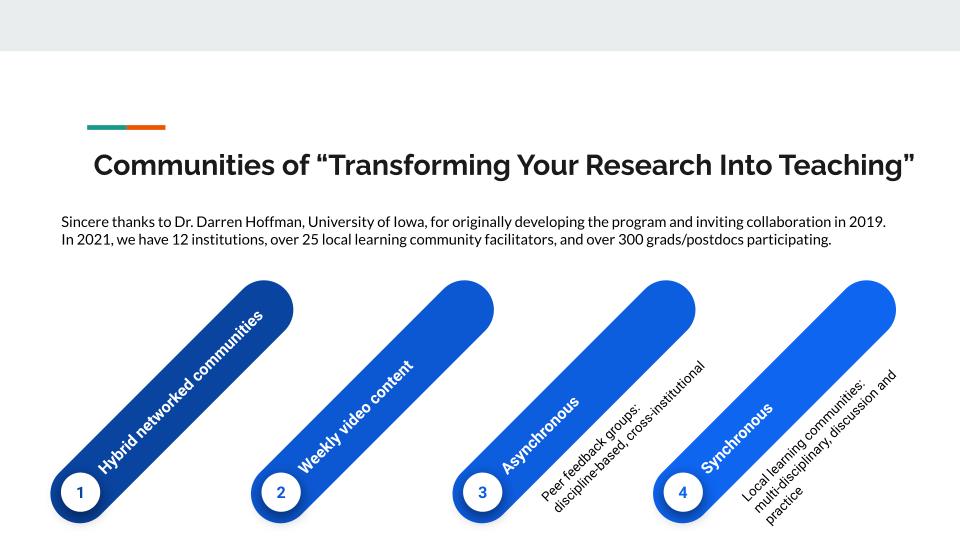
The candidate mentions that their course idea was developed with the support of peers and mentors in the pedagogical development experience, Transforming Your Research Into Teaching (TYRIT). They proceed to describe their experiences in TYRIT, a hybrid-design, multi-institution, seven-week workshop series in which graduate students and postdocs translate their research expertise into an advanced-level course. Once a week, they attend a synchronous learning community with 10-20 other participants to discuss recorded content about course design (e.g., backward course design, assessment, active learning approaches, and equity in the classroom), delve deeper into topics, resolve questions, participate in mixed-discipline discussion groups, and engage in peer feedback on their course projects.
What makes TYRIT special?
Dear reader (imagined to be a mentor to grads and postdocs), you might be thinking:
“Lots of institutions have course design institutes, big deal. Why would my institution, my students, or I choose to be part of TYRIT?”
You’re right, your institution probably does have a course design institute – and it’s probably reserving seats for faculty and prioritizing faculty immediate needs for teaching a known course a couple weeks to a semester in the future. I’m positive it’s a great experience for those faculty – I trust and value the work of my colleagues in educational development tremendously.
And also, as a co-designer/facilitator of TYRIT, I believe graduate students and postdocs benefit from their own space of extended engagement and accountability to unpack, deconstruct, witness, reintegrate, re-story, and gain shared perspective about personal and career concerns that are developmentally appropriate for them. Meeting weekly with peers across institutions through four time zones and multiple climate zones, participants break out of their habituated and often constricting ingroup/outgroup discourse communities and find new colleagues with shared interests. The walls and armor of allegiance to discipline and institution fall away in the multidisciplinary and multi-institutional space. They talk about feeling more at ease to share their experiences and dreams in the TYRIT groups. There is a feeling of renewal, possibility, and goodwill in our weekly learning communities, and we often hear participants talk about the importance of feeling part of something bigger as they consciously and conscientiously interact with people hundreds of miles away on the same goals of preparing for academic job interviews or teaching fellowship applications. While faculty attending a course design institute likely have an assigned course they are designing for, graduate students and postdocs are probably creating course materials for imagined institutional and student contexts. Thus, their course proposals are a deliberate opportunity to align and give narrative to their values, interests, personality, experiences, background, and identities (including academic identities).
Proof of concept
TYRIT came about because eight people, each leading their own course design institutes for graduate students and postdocs at different institutions, thought there must be a better way to do this. We were each delivering the same course design content in workshops, and we were finding ourselves reiterating the content in one-on-one consultations about job application materials. Drawing upon previous work from a member of our team, we started asking questions about the potential design of a course institute for grads and postdocs:
- What if content was delivered centrally as recordings?
- What if time-on-task was re-allocated to communities of accountability and feedback?
- What if grads and postdocs got to interact with peers at other institutions, reaping intrinsic and extrinsic benefits like we did as practitioners collaborating across institutions?
- What if multi-institution hybrid workshops weren’t just about delivering content at scale, but about supporting communities of belonging and purpose?
- Is there a need for this kind of course design institute among grads, postdocs, and pedagogy mentors? Will people come to the party?
- What benefits do they (and we) see from this flipped format?

We launched TYRIT in 2019, three months after our first conversation about it. With only local advertising at 8 participating institutions, 80 people enrolled. In 2020, we offered the program through the CIRTL Network, and over 200 people enrolled. Yep, the summer of 2020. Thank goodness we had our 2019 practice run when we had already figured out Zoom breakout rooms, shared Google Drives, and weekly online facilitator meetings. It was strangely NBD (no big deal) to teach TYRIT completely online during the early months of the COVID pandemic. In fact, it was a comfort to me to have the structure, tasks, and regular community to look forward to when so much else was dire and uncertain. If I’m going to be in a Zoom meeting, I beseech the Great Spirit and Higher Power to let it be a TYRIT Zoom.
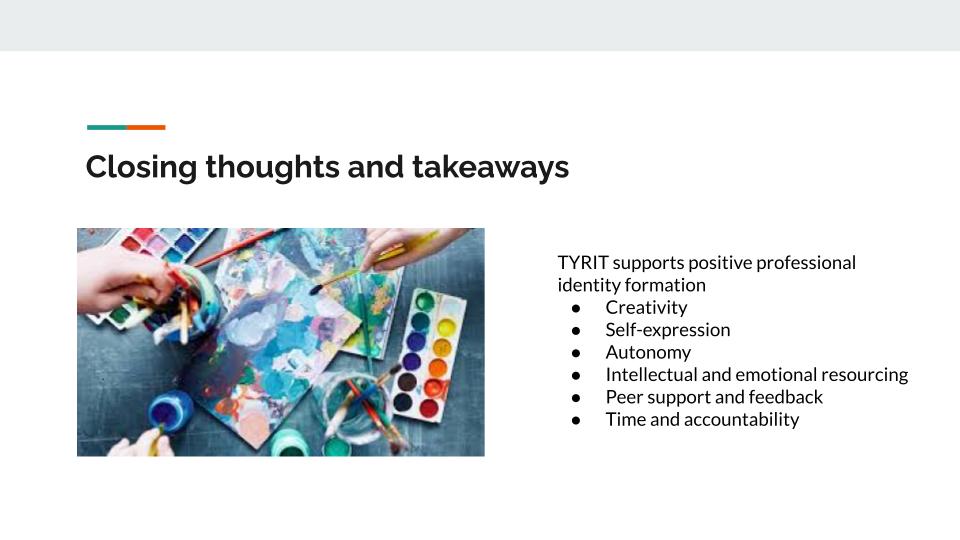
There is indeed a need for TYRIT among grads and postdocs AND grad/postdoc educational developers. Summing over the five iterations of the workshop series between 2019 and 2023, almost 1000 graduate students and postdocs have enrolled in TYRIT with an annual completion rate between 40-60%. Between 8 and 12 institutions have hosted a learning community each year, facilitated by between 10 and 20 staff in teaching centers and graduate schools. Since we began multiple assessment projects in 2020, we have published two research papers and have one on the way about the outcomes of TYRIT for participants and for the facilitators. For both participants and the facilitators, TYRIT supports positive professional identity formation by supporting creativity, self-expression, autonomy, intellectual and emotional resourcing, peer support and feedback, and time and accountability. For me, it has been a truly productive, rewarding, enjoyable program to support, facilitate, and study with colleagues.
My origin story with TYRIT
I was at the origin of TYRIT in its multi-institution form. In March 2019, eight people who barely knew each other joined a conference dine-around at a sushi restaurant in Newport Beach, California. Although we each had different academic roles – staff in teaching centers, assistant deans in graduate schools, academic researchers, pre-tenure faculty – we shared passion for the teaching support of graduate students and postdoctoral scholars. We entered the restaurant as strangers to each other trying to survive hours of conference meetings. We left having planted an idea-seed that rapidly sprouted (four days later, according to my email deep-dive) into the multi-institution collaborative project, “Transforming Your Research Into Teaching” (TYRIT). The seed called TYRIT, a course design series for graduate students and postdoctoral scholars across North America, flourished into a five-year garden that has been the most transformative and generative experience of my life.
I had been debating going to that conference in March 2019. I was two months into a new job after feeling like I had stagnated since the 2016 election in a job I loved. I was feeling miserable from a head cold. (NB This was the covid Before Times. While it was literally just a regular cold for me, I also hadn’t yet learned to be more responsible about keeping other people safe from colds). Our flight path over the Sierra Mountains didn’t help my ears at all as the plane jostled and the cabin air pressure changed. I remember the distinct shift in color palette out the window as we left the eastern Nevada-desert side of the mountains to the brilliant greens, yellows, and purples as spring was arriving on the western slope. I only went to the welcome reception the first night because I was hungry from travel, I couldn’t bear the effort to find someplace to eat, and I didn’t feel like I would be good dinner company. A friendly acquaintance found me, got us a small table at the hotel bar, and bought us fried avocado to share. I highly recommend it – the friend who will keep a feeling-puny person company AND the fried avocado. It cures what ails.
In my nostalgic recollection of what came to be called Sakae Sushi dinner the next night, I remember sensing magic at the table. The right people. The right personalities. The right readiness in each of us for something new. The right energetic state of trust, humor, creativity, and collective wisdom. The right spark of an idea. Even the incidental details I remember about that dinner seem slightly fantastical. The originator of the spark, a stranger who has since become like a brother to me, was wearing a Captain America t-shirt to dinner. The group walked to the beach at night after dinner; I and Captain America waded up to our ankles in the frigid Pacific water, cackling as we supported each other’s requisite ocean purification ritual. We made ongoing jokes about stopping by the Taco Bell Cantina on the way back to the shuttle for a Mountain Dew Baja Blast. Even as we rode back to the hotel with other dine-around groups and spent the next days with the larger group, we recognized and spoke our internal language with each other.
The following week, my email filled with messages accounting for Baja Blast sightings in our various home cities. (I’ve never had a Baja Blast, and I probably should for the legitimacy and completeness of the story). My emails from that week in late March also include the requests for meetings to figure out how to make TYRIT an inter-institutional reality by June 2019. The core group has stayed largely the same over the past five years and we’ve had reunions of several kinds since then. We meet up at conferences for sushi dinners. During the height of the pandemic, we had weekly happy hour gatherings on Friday afternoons (“Zoom-beers”) to socialize, share hobbies, and support each other’s practice of educational development during a pandemic.
My experience with TYRIT was truly magical, especially during a period when the world and aspects of my personal and professional life faced extraordinary challenges. Healthy, communicative, functional relationships. Camaraderie, collegiality, collectivism, distributed leadership, democratic decision-making with a dash of generous authority when needed, mentorship. It boosted my hope that good things are possible. I grew in compassion for colleagues and participants as we shared stories of difficulty, growth, and achievement. I gained project management and research skills. I made new friends and research collaborators. I grew in my knowledge of my strengths and I grew in my commitment to supporting the identity formation of becoming-scholars through community-building.
The way I felt being part of the TYRIT community mirrors the way I felt being part of music communities in high school and college (mentioned in this post, Music Lessons): “I wasn’t consciously expecting music to rescue me from the chaos. I was, however, drawn to the relief of belonging and our mutual investment in each other’s best work. Through music, I participated in a complex ecosystem of communities of peers, mentors, and mentees where I could be both vulnerable and courageous.” Replace every occurrence of “music” with “TYRIT” and it feels equally as true in my mind, heart, body, and spirit. Like my experience with music in my late teens, TYRIT has been a complex and dynamic ecosystem that saved me and was where the chaos wasn’t. More than any institutional success measure of reach, scale, or academic output of publications and presentations, TYRIT was my guide and North Star looking out for my personal and professional wellbeing.
 Katie Kearns