
“I just had the best day of teaching grad pedagogy, about love in the classroom with things from Parker Palmer and bell hooks. So good.”
I had to text Louisa (not their real name) about my class. Even though I was exhausted after three hours of teaching, I was elated. I was certain that I had spent three hours on a Friday afternoon putting my experience and skills to proper use. My purpose had been in flow with my students.
Seconds later, my phone rang. It was Louisa.
“I had to hear your story and the excitement in your voice firsthand! Tell me more!”
We spent our commutes home, hundreds of miles apart, sharing teaching stories and gushing over how meaningful and fulfilling it is to support the formation of graduate students and postdocs. I lift up Louisa as the person who, over drinks at a conference this past June, helped me keep my spark lit by telling stories about their own recovery from professional burnout. Before we hung up on Friday, I laughed as I told Louise that these types of drive- or walk-calls are usually about one of us coming apart and needing to be put back together. Instead, this sharing-the-joy call launched me straight to the moon. The call from Louisa amplified my feel-good hormones, extended the reach of my vibrational energy from class into my friendship, and formalized the significance of that particular class period through witness and testimony.
So what’s one thing love’s got to do with teaching? Friends love to tell friends the good news about their teaching. I hereby promise that when one of my friends texts me great news, I am going to call them right back to hear about it in real time in their own voice.
There’s more to love than sex
After a couple hours at home in solitude and mental quiet, I arrived a couple hours late to a small holiday gathering last Friday. This gathering was among new friends, some who work in higher education and some who don’t.
“I didn’t know you were teaching this semester. What did you do in class today?”
“We talked about love and fear in the college classroom. It’s for a graduate course in pedagogy. I teach graduate student teachers how to teach.”
I think it’s interesting how people respond when I mention I love to teach about love in the classroom. They hear “love” and think about sex, romance, attraction, power dynamics, crossed boundaries, inappropriate relationships, coercion, and Title IX. I say the word “love” and I can see the physical reactions of discomfort and revulsion in their bodies. People’s thoughts and responses aren’t wrong; unfortunately, there is misuse of love in the classroom and too many of us have been harmed by that misuse.
When people ask me to say more about what I mean by love in the classroom, I usually reference bell hooks’ book, All About Love, which delivers on its title. From the second page of chapter one, she introduces a quotation about love from Erich Fromm that I find elucidating: “the will to extend one’s self for the purpose of nurturing one’s own or another’s spiritual growth…an act of will – namely both an intention and an action. Will also implies a choice. We do not have to love. We choose to love.”

“Love” as a spoken word doesn’t have a comfortable place in the dominant culture’s college classroom, unless it’s the tough kind. Mostly, love as I’ve experienced it in college classrooms at large research universities is practiced as benign emotional neglect; we don’t talk about what we want or need nor how we are affected physically, psychologically, and spiritually by ideas, the world, or each other. I think that’s lying by omission and dissociation, though; we ARE affected in our bodies, hearts, and spirits in class, even if we’ve learned not to feel it or express it. The dominant culture maintains a tacit agreement not to talk about how something lands for us. We don’t know how to hold space, how to re-engage the brain with the body, how to talk about the internal experience, nor how to keep each other emotionally safe.
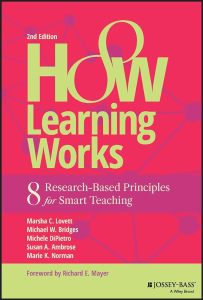
We aspire to uphold the narrative that higher education is the “life of the mind” and the world of ideas. We’re socialized to think of college classrooms as solely “thinking” spaces where teachers interact with disembodied minds about content and ideas. And we might secondarily think of college classrooms as hands work through the “doing” of tasks like writing and performing experiments. Our main text for the pedagogy course, How Learning Works, mirrors that approach, with each chapter exploring theories of cognition, memory, recall, and feedback (“thinking” as a teacher; the head) and then offering examples of classroom practices to support learning (“doing” as a teacher; the hands). I know that my students are enrolled in the course to meet goals related to interacting with more pedagogical theories and gaining more pedagogical practices. Not a week goes by where I don’t experience self-doubt about whether I’ve covered enough “thinking” and “doing” for my version of this course to pass external scrutiny.
One of my hidden yet primary goals in this class is to help my graduate students with “being” (the heart) and supporting “being” in the classroom. Ask anyone with a non-normative body (gender, race, disability, age, size, sexuality, the list goes on) and they will tell you that aspects of their bodies and lived experience feel unloved and sometimes unwelcome – and even fearful – in the college classroom. Without using the word “love” explicitly, we’ve talked around and through love and “being” throughout the semester with topics like experiences of trans students and group work, teaching neurodiverse students, the importance of empathy in the first weeks of the semester, and trauma- and healing-informed pedagogy.
In the last couple weeks, we’ve broached love head-on with readings from wise elders and ancestors including bell hooks, Parker Palmer, Audre Lorde, and James Baldwin who have served as teachers and guides to me. I want my graduate students, who are current and future college educators, to deepen their concept and embodied sense of (appropriate) love in the classroom. I start with where we typically do feel comfortable using the word love in a higher education context. For example, it’s socially acceptable to say we love our fields of study (“I love biology”) and love the act of teaching (“I love the feeling of a student’s a-ha moment”). And then I ask my students to get curious about that love. What IS that feeling of loving our field or teaching? What are we sensing in our bodies? Bodies leaning in, energized, engaged, in flow. What is that sensation encouraging us to do? Connect, collaborate, create together. It seems to me that is what the common, romantic feeling of love can feel like, too. I think we need a richer language for talking about the act and feeling of love in the classroom.
Ancestor bell hooks and Elder Parker Palmer to the rescue!
Last Friday, after watching a short video interview with Parker Palmer talking about teaching and leading, we made a two-column list of words we heard related to love and fear. We also skimmed for love- and fear-related words from readings in Teaching Community (hooks), All About Love (hooks), and Courage to Teach (Palmer). We then shared examples of the ways we’ve experienced love and fear as students and practiced love or fear as teachers. One student pointed out examples from that class when we ourselves spoke from a place of shame in this class: “This might be a stupid idea…” and “I don’t know if this makes any sense…”Another student remarked about the ways abundance and hospitality show up in our class through the real potluck of snacks and the metaphorical potluck of pedagogical ideas and experiences.
| Love | Fear |
Hospitality Grace Appreciation Harmony Collaboration Curiosity Resourcefulness Courage Generosity Abundance | Scarcity Competition Judgment Blame Manipulation Competition Shame Self-suffering Disempowerment Silence |
As my pedagogy course approaches the end of the semester, I want for my students to be able to draw upon a deeper wisdom and intentionality about the ways they engage with their students. Beyond having a toolkit of ideas and strategies, I want them to have an inner knowledge about “being’ in the classroom, what feels right and loving for them and their students. Do they want to run their classrooms from a position of being loving (and being loved) or from a position of being feared (and being fearful)? How do we want the experience to feel for ourselves and our students?
We acknowledged that there are aspects of our classroom practices that come from a history and culture rooted in aspects of fear, control, and mass production. The whole thing won’t be undone overnight. But to choose transparently, deliberately loving practices in our own classrooms is to choose to be rebellious. We can choose what our ancestors and elders wish they had experienced as learners and teachers.
One thing I loved was how much I grew in my own understanding of love through that conversation with my graduate students. Although I inhabited their roles some 20 years ago, their experiences as learners and teachers are both universal and situated. The ways fear shut them down and the ways love opened them up are important stories conveying our simultaneous uniqueness and connectedness.

 Katie Kearns
2 thoughts on “What’s love got to do with teaching?”