Almost 25 years ago, I printed out the final copy of my dissertation and placed the original cover sheet signed by my committee members on top. I put it in a manila envelope and walked it over to the main library. The drop-off spot was in the dimly lit basement of the graduate school library. A man behind the counter received the envelope. He might have checked inside the envelope for that all-important cover page, but I don’t remember.
“Am I in the right place? I’m dropping off my dissertation.”
“Yep, I’ll take it,” he said.
I handed over the manila envelope containing some 200 pages of paper. It represented successful completion of advanced coursework and multiple attempts at a good match with an advisor, research group, and project. It represented weeks of non-stop writing and three chapters submitted for publication in peer-reviewed journals. It represented multiple trips to the graduate school office to get the formatting right. It represented multiple print runs before I finally discovered that the department’s printer was just very slightly cockeyed in its printing.
Did he understand how precious that folder was, what it contained in ideas, time, toil, discussions, signatures, degrees, and job prospects. Did he know what power the sheets of paper inside held for me? Maybe, maybe not. Who knows. I had certainly imbued the contents of that manila folder with potent magic. I think he was largely immune to that magic. His job was to receive the dissertations and process them for digital storage with ProQuest and physical binding.
“That’s it?” I asked.
“That’s it.”
That was it. A simple exchange of words. That last step of the PhD journey was surprisingly noteworthy to me in that it was surprisingly unnoteworthy, uneventful, and unceremonious. I was expecting a shared happy dance and congratulatory handshake. Maybe I was expecting too much at the end of the PhD journey. Just know that if I were running that basement-floor desk in the library, I would dance for you, shake your hand, and say “Congratulations, Doctor.” And for the record, I had a really fantastic celebratory party with my lab group at La Cazuela (Athens, GA) after my dissertation defense.
This past Wednesday had a very similar feel to it. Quiet, solitary, unceremonious, ordinary, and unnoteworthy. I submitted final grades without fanfare. I turned in my campus parking pass and got a refund for the prorated days. I drove home. And that was it. With the culminating, coda experience of teaching a graduate course in college pedagogy this fall, I have closed out a nearly 20-year chapter of my life as an employee of this university. That’s it. “For now,” a close friend always adds.
I have been compassionately harvesting pedagogy lessons from this past semester teaching a graduate course in college pedagogy (link to the syllabus). I’ve written about the course before at the start of the semester, about a lesson on motivation, and after a great experience teaching about love and fear. Harvesting seems like an appropriate word given the end of fall and beginning of winter is upon us. Merry Solstice/Yule! Parker Palmer’s poem, The Harrowing (you can find the poem here and below) offers grace and guidance about harvesting and plowing, reminding us to plow, not to dig up the past and find all the faults, but to prepare for the future growing season.
Harrowing
by Parker J. Palmer
The plow has savaged this sweet field
Misshapen clods of earth kicked up
Rocks and twisted roots exposed to view
Last year’s growth demolished by the blade.
I have plowed my life this way
Turned over a whole history
Looking for the roots of what went wrong
Until my face is ravaged, furrowed, scarred.
Enough. The job is done.
Whatever’s been uprooted, let it be
Seedbed for the growing that’s to come.
I plowed to unearth last year’s reasons—
The farmer plows to plant a greening season.
Here’s my process for “harvesting” some of my growth-minded lessons from teaching this pedagogy course. Assuming readers of this blog are predominantly graduate students, educational/career developers, and friends, maybe this process for curious, honest self-reflection helps other new teachers be gracious, hospitable, kind, and encouraging to themselves as they harvest their own lessons from experiences. I gave myself 30 minutes to write about the following questions.
- What am I grateful for?
- What did this add to my treasures?
- What do I have regrets about?
- What would I do differently?
- What do I have to work on?
- What have I learned about myself?
- What are the bigger lessons?
I have handwritten notes from each of the questions. I am choosing to summarize my responses to question #7 here: What are the pedagogical and professional lessons for me in teaching a graduate course in college pedagogy this fall?
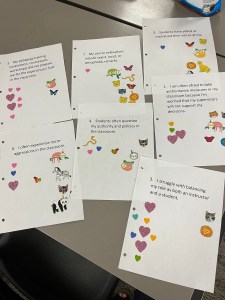
- Even a highly experienced pedagogy coach reverts to near-novice status and behaviors with a new teaching assignment. I feel like I hovered around conscious competence most of the semester, with occasional slips into conscious incompetence and occasional glimmers of unconscious competence.
- I prefer and am more skilled at low hierarchy groups with shared purpose such as learning communities, communities of practice, and special interest groups over courses as approaches for facilitating learning together and creating collective experiences.
- I thrive with thought partners and my own community of practice as support when trying something new.
There are lessons for me about this fall semester that are deeper than the worldly, strategic and tactical pedagogy lessons. They are lessons about inner journeys and shadow work. I think a part of me had expected to conjure through the syllabus and the semester the perfect, magical, enlightening synthesis of about 20 years of accumulated wisdom and practice. I think somewhere in my sub- or unconscious, I wanted to prove through performance that I had learned something significant over 20 years about pedagogy by working in a teaching center and graduate school and could prove-through-practice my expertise. Like the dissertation, I think my sub/unconscious wanted to feel the liberation I felt when I was 26 years old from a signed paper by a powerful committee, “You have passed the feats. You are ordained and degree-conferred. Go forth and prosper.” That was an unfair, unreasonable, and hidden power and burden to both me and the students. That’s ego talking, trying to protect self-doubts and fear about my accumulated wisdom about pedagogy. The magic and power of the experience of that class was not in the syllabus or in my own harshest critiques about pedagogical know-how of the semester.
The magic was in the little moments and inner journeys of courage and vulnerability within our group. Sharing small objects of meaning to get to know each other on the first day. Decorating our name tags each week with new stickers. Inside jokes about “our friend Paulo” (Friere). Getting to read their weekly reflections on readings, where I got to hear their recurring concerns and developing threads of insight. The ways someone would always point back to one of our guest speakers or readings. When members of the class contributed to the pedagogy potluck with their own disciplinary knowledge or teaching experience. When a student, with an ache in their heart, shared with all of us a difficult story from their own classrooms and asked for support and guidance. When a life or world event disrupted a student’s faith in human kindness. The snacks we shared every week, especially bananas (Do you want an interesting debate among colleagues? Ask people about their preferred banana ripeness). The end-of-semester pizza party at Mother Bear’s with a buffet of signature half-pizzas – don’t forget the ranch dressing. And “Stevia,” the plant one of the students cared for, brought to class each week as another member of the class, and is now a resident of my house. The class group photo at the end that one student glammed up.

Of course the magic moment wasn’t in turning in the grades or putting the teaching experience on my CV. Just like the unnoteworthy reception of my bound dissertation in the basement of a library, grades and CV lines are just public representations that hardly capture the worldly and inner lessons. I return to my unspoken questions to the librarian: Do they understand how precious that line item was, what it contained in ideas, time, toil, discussions, signatures, degrees, and job prospects? Maybe, maybe not. But I do. The harvest from this experience is precious. One lesson I am harvesting is that facilitating courage and vulnerability in a group is the skill I’ve practiced and valued the most over these 20 years. I am harvesting a lesson in gratitude to dozens of people who have participated in two decades of college pedagogy experiences with me. I am also harvesting the lessons that I had the courage to try, the vulnerability to be authentic with my students, and the willingness to learn what needs to be learned.
 Katie Kearns